- EN
- TR
Four Years in Iran: Myron Bement Smith and the History of Islamic Architecture in Iran
Thursday, December 11, 2025 - 18:30
Location:
Pera Museum Auditorium
Host:
David J. Roxburgh
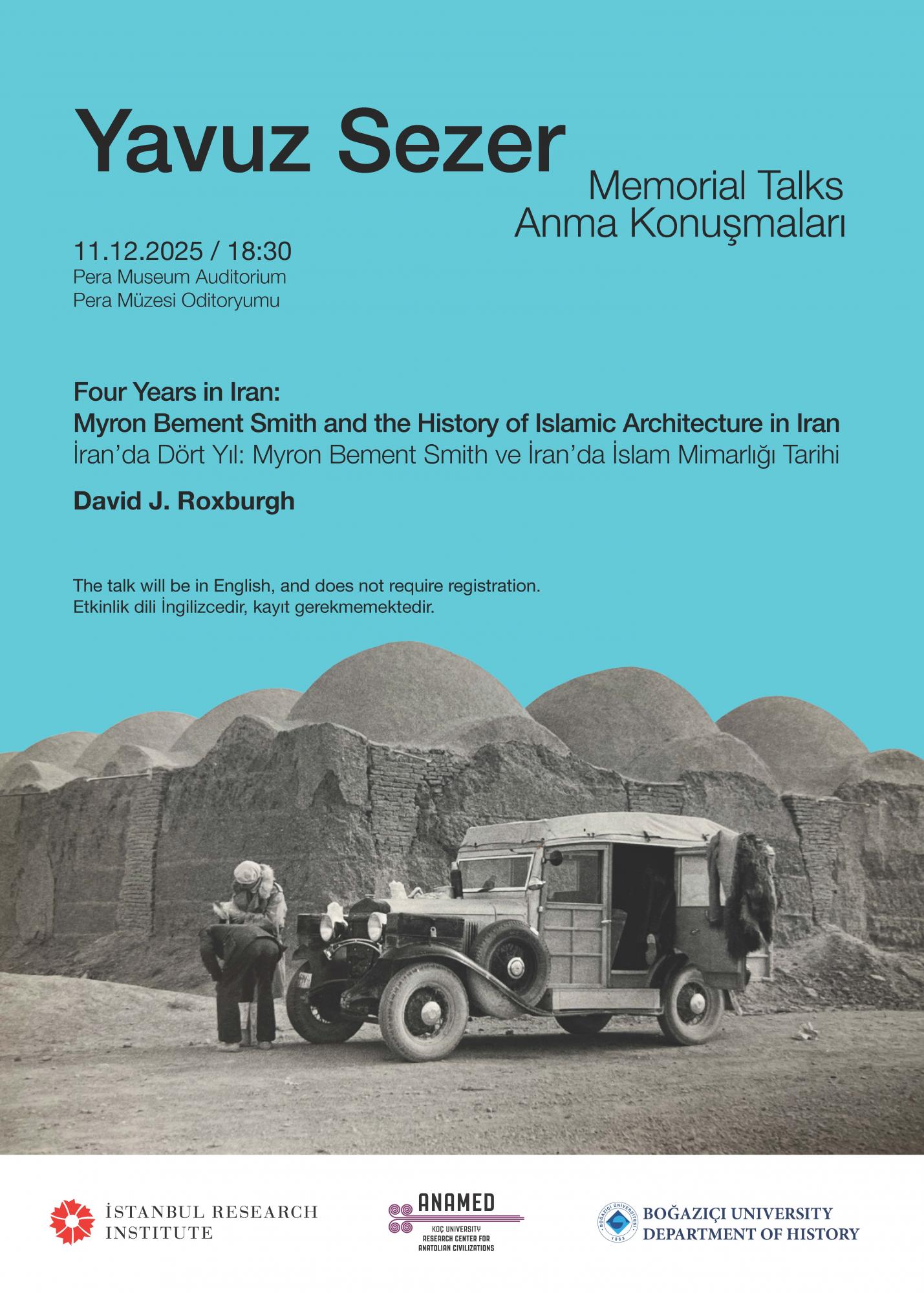
Four Years in Iran: Myron Bement Smith and the History of Islamic Architecture in Iran
11 December 2025 / 18:30
Art, architecture, and archaeology played a new nation-building role in Iran among the modernizing reforms initiated by Reza Shah Pahlavi (r. 1925-1941), who also mandated that Islamic architecture now be made available to non-Muslims. A scramble for access and study ensued. While the story of this “first start” of academic inquiry by non-Iranian architectural historians continues to gain sharper focus in scholarship, one figure remains neglected, mainly and virtually forgotten: the American Myron Bement Smith (1897-1970).
Smith arrived in Iran late in 1933 and conducted fieldwork there until 1937, sponsored by the American Council of Learned Societies. Alienated from his American contemporaries—who gathered around the impresario Arthur Upham Pope—Smith sought an alliance with André Godard, Director of the Iran Bastan Museum in Tehran, and conducted four years of fieldwork, producing a steady stream of monographic studies on Islamic-period monuments throughout the 1930s. His return to the United States in 1938 was followed by a protracted period of scant opportunity. Though he completed his PhD at Johns Hopkins University in 1947, his study of the vault in Iranian Islamic Architecture remains unpublished.
How might our understanding of the history of the study of Iranian Islamic architecture be different by defining Smith’s approach to architecture as an object and field of study, and in triangulated relation to those approaches adopted by his peers?
The lecture, led by David J. Roxburgh, draws from Smith’s vast archive, which was gifted to the Smithsonian Institution in Washington, D.C., in 1972.
The talk at Pera Museum Auditorium is free of charge and does not require registration. The event will be in English.
About David J. Roxburgh
David J. Roxburgh, Prince Alwaleed Bin Talal Professor of Islamic Art History, Harvard University,completed an MA at Edinburgh University in 1988 and a PhD at the University of Pennsylvania in 1996. He has taught at Harvard since 1996.
His research focuses on art and architecture in Iran and Central Asia from the Mongol through the Early Modern periods. His publications include studies on albums, primary sources in Arabic and Persian (e.g. album prefaces, travel narratives, how-to treatises), art of the book, diagrams, and calligraphy. His curatorial projects include Turks: A Journey of a Thousand Years (2005, Royal Academy of Arts), Traces of the Calligrapher (2007, MFAH), and Technologies of the Image (2017, Harvard Art Museums). Roxburgh has also contributed essays on histories of collecting, exhibitions, and museums to edited books and journals.
He is currently working on a book to be published in two volumes from the archive of Myron Bement Smith.
Son Güncelleme: 08:47:58 - 05.12.2025